VIMAX PROJECT
Factor is leading VIMAX, a research and development project aimed at creating an advanced in-line metrology system capable of measuring complex mechanical parts directly alongside the manufacturing process, with micrometric precision and without disrupting the production rate.
The solution will combine 3D machine vision, three-dimensional reconstruction, artificial intelligence, robotics, and industrial automation to move towards a faster, more accurate quality control model that is fully integrated with production.
The project is being carried out under the 2024 call for Strategic Cooperation Projects of the Valencian Innovation Agency, now IVACE+i Innovation, and is funded by the Generalitat Valenciana and the European Union.
VIMAX brings together a Valencian consortium coordinated by Factor, with the participation of the University Institute of Automation and Industrial Informatics (AI2) at the Universitat Politècnica de València, AGFRA, S.L., and Photonic Sensors & Algorithms, S.L.
Industry Challenges
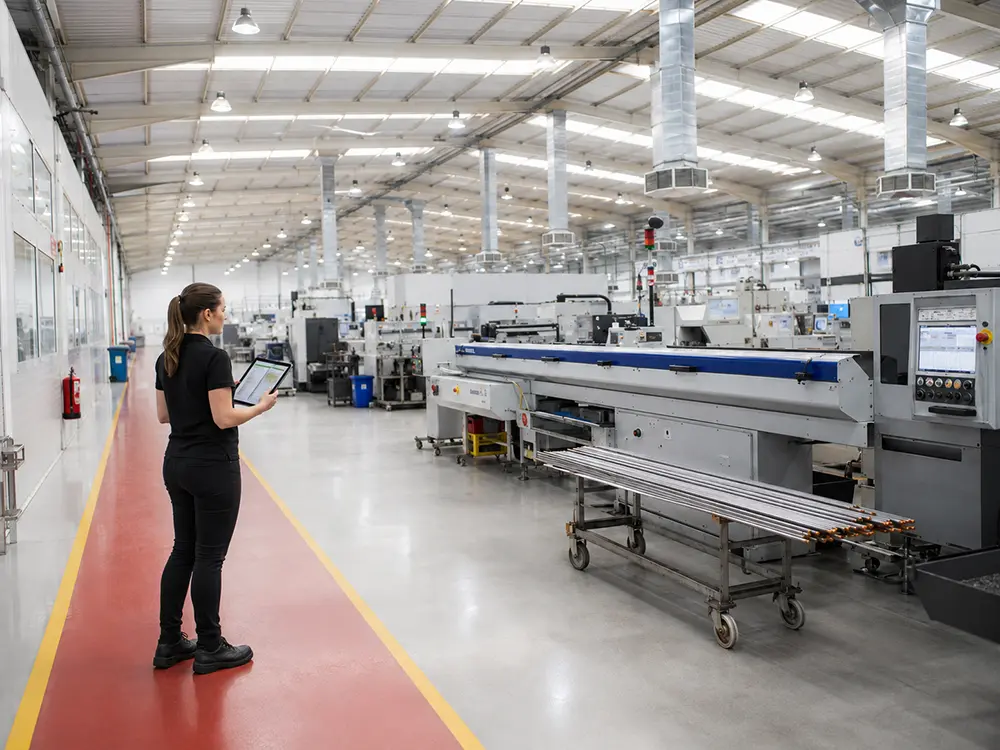
The manufacture of industrial components requires working with increasingly complex parts and very tight dimensional tolerances. However, many quality control processes are still carried out off the production line, using manual procedures or inspections based on a limited sample of the units manufactured.
This can delay the detection of deviations. When a defect is identified after several units have already been produced, it can lead to rejected parts, rework, production downtime, and unnecessary consumption of materials and energy.
VIMAX seeks to bring advanced metrology directly into the manufacturing process, moving from manual, offline, and sample-based checks toward automated inspection capable of verifying 100% of the parts produced and detecting potential deviations at an early stage.
Technological Innovation
VIMAX is not merely focused on developing a new camera or a standalone measuring device. The project is centred on a comprehensive inspection system in which different technologies work together in a coordinated manner.
The solution is based on three main elements:
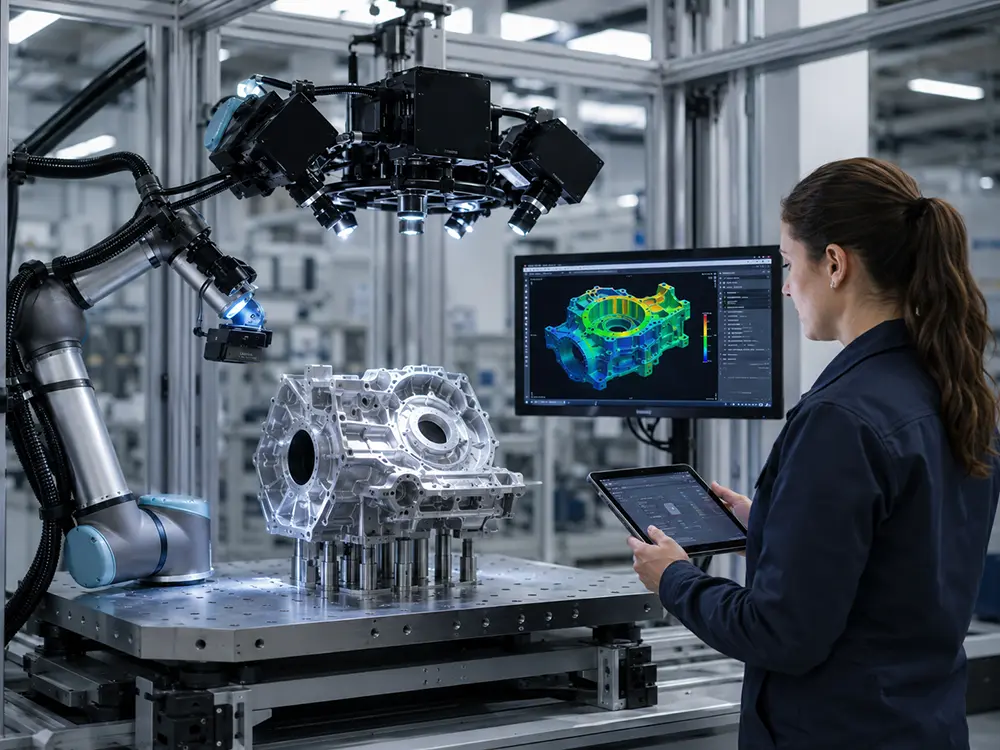
- A high-precision 3D multi-camera vision system, whose cameras, developed by PHOTONICSENS, simultaneously capture image and depth data. The project is investigating ways to improve their accuracy and determine the optimal configuration.
- Advanced reconstruction, measurement, and analysis software, incorporating AI, which will reconstruct the part’s three-dimensional geometry and calculate its dimensions for comparison with the reference model and previously established tolerances. The system will identify dimensions that fall outside tolerance and display the results through a graphical interface and deviation maps.
- An automated inspection station, supported by collaborative robotics, to position and manipulate parts and coordinate the measurement process.
The integration of these technologies —advanced photonics, 3D machine vision, geometric analysis software, robotics, and industrial automation— will enable the automation of data capture, part positioning, data processing, and the generation of inspection results.
The system will be validated to verify its accuracy, robustness, and repeatability, as well as its ability to meet the requirements of an industrial production process.
Key Aspects of the Project
VIMAX is structured around five main pillars:
- High-precision in-line metrology, designed to inspect parts with micrometric tolerances directly alongside the manufacturing process.
- 100% production inspection, moving from sample-based inspection to the verification of one part per production cycle.
- 3D reconstruction and analysis, using algorithms capable of processing the information captured by cameras, generating three-dimensional models, and comparing the measured dimensions against the defined tolerances.
- Measurement of complex geometries, including external and internal dimensions, and avoiding, whenever possible, destructive operations such as cutting the part to verify internal dimensions.
- Automated inspection, using an autonomous station with a collaborative robot or industrial automation system to position the parts and coordinate their measurement.
Factor’s Role
As the project coordinator, Factor brings its expertise in industrialization, CNC machining, and the manufacture of high-precision metal parts.
The company participates in selecting the parts and geometries to be studied, defining industrial requirements, and adapting the technological developments to the actual needs of manufacturing processes.
Factor will also lead the validation of the VIMAX prototype, providing the pilot environment and its industrial expertise to configure the system, conduct functional tests, and evaluate its potential integration into a production environment.
This participation connects the consortium’s scientific and technological expertise with the real-world needs of production, quality control, and industrial metrology, helping to ensure that the final result is useful, scalable, and capable of evolving into a commercially viable solution.
Impact on the industrial Sector
VIMAX aims to advance towards a new generation of dimensional quality control, capable of identifying deviations at earlier stages of the production process and generating information associated with each manufactured part.
Having access to this data will improve process traceability, enable the analysis of trends and incidents, while providing more information to optimize manufacturing conditions.
In-line inspection can also help reduce defective parts, rework, and inspection times, as well as improve the use of materials, energy, and production resources.
The future implementation of these solutions may be particularly relevant for companies working with high-precision components in sectors such as industrial machinery, automotive, electronics, aerospace, defence, and healthcare.
With VIMAX, Factor reinforces its commitment to advanced manufacturing and the development of technologies aimed at creating a more precise, efficient, and competitive industry.
- Hits: 274